This blog is designed to keep you up-to-date with Careers Education, Information and Guidance (CEIAG) available locally, nationally and through the school. I’ll be posting information about employment and training opportunities available locally as well as details of open days and useful websites. The world of education, employment and training opportunities is changing rapidly so keep checking in for the latest information.

Mr Cross


Showing posts with label General Information. Show all posts

Sunday, 30 June 2024

Why do we go to work?

While earning an income is largely about supporting you and any dependants, achieving fulfillment through you working life is also important.  Especially with the ever-increasing age at which you can qualify for a state pension to support your retirement ...


Sunday, 20 February 2022

Young returners to work are in insecure employment


A report by the Resolution Foundation has found that young people had returned to work rapidly in late 2021, with unemployment now slightly lower than pre-pandemic levels, but a third of the 18-34 year-olds back in the workplace were now in "insecure work". The young "returners", those who were employed pre-Covid but became unemployed in the pandemic, were now much more likely than those who stayed in work to be on a temporary or zero-hours contract, or doing agency work or unsteady hours. 33% of the returners, among 6,100 people surveyed by YouGov, were now in such roles, compared with 12% of those who had stayed in work throughout the pandemic.

Wednesday, 12 January 2022

The Gender Pay Gap is widening

The "gender pay gap" reported to the government by Britain’s biggest firms is widening, prompting warnings that women face a bleak and worsening economic picture in 2022. Three years after a new law compelled companies to reveal the difference between male and female wages, data shows that 8:10 organisations with more than 250 staff still pay men more than women. The most recent data shows women are being paid a median hourly rate 10.2% less than their male colleagues, nearly a percentage point higher than the 9.3% gap reported in 2018. The pay gap in the private sector grew from 8% in 2018 to 9% in 2021, while, in the public sector, it grew from 14.4% to 15.5%.

Monday, 15 November 2021

Increase in graduate and school-leaver salaries but ...

A survey by the Institute of Student of Employers (ISE) has found that the typical pay for graduates rose to £30,500 in 2021, up by £833; while school leavers saw a jump of £1,039. However, the number of applicants per job reached a record high of 91 per graduate vacancy, a 17% increase on last year. It also marks the highest number since the ISE started collecting data in 1999. The 2021 cohort of graduates has been competing for jobs against last year's cohort, who graduated in the year the pandemic began. The 177 respondents, each large employers of students and young people, suggested that the jobs market had still not recovered to pre-pandemic levels.

Thursday, 23 September 2021

Current shortage occupations


The list of the 10 occupations where, according to the Recruitment and Employment Confederation and industry data, worker shortages are among the most acute are

• HGV drivers - 100,000+

• Nurses - 79,123

• Programmers and software development professionals - 68,929

• Care workers and home carers - 49,751

• Primary and nursery education teaching professionals - 30,574

• Chefs - 29,996

• Sales and retail assistants - 26,183

• Cleaners & domestics - 24,148

• Metal working production and maintenance fitters - 19,748

• Carpenters and joiners - 6,364

The jobs covered by the government's approved list currently include all health professionals, vets, architects, engineers, scientists and orchestral musicians.

Monday, 16 November 2020

Increase in Job Vacancies reported

A survey by the Recruitment and Employment Confederation has found there were 1.36 million job adverts across the UK in the first week of November, the largest number since early March. However, the research shows the recovery has not been evenly distributed across the different regions and sectors. Half of the UK's major regions now have higher numbers of job adverts than in March, while some still have fewer. The bounce back has been led by North-West England and Wales, which last month respectively had 37% and 33% more vacancies than in March, but London is lagging behind with 18.7% fewer posts on offer. The study also shows roles in construction, logistics and food and drink have recovered strongly, while hospitality and leisure remain at significantly lower levels than in March. However, there were 48.7% fewer adverts for bar staff than in March, despite a recovery during the summer months. Vacancies for chefs were down by 46% and for fitness instructors by 37%, significantly lower than before the pandemic hit.

Wednesday, 9 September 2020

Working during Furlough


A study by economists from Oxford and Cambridge universities has concluded that the majority of people who were furloughed have carried on working during lock-down, with men significantly more likely than women to flout the rules. It also found that women were significantly more likely to be furloughed than men doing the same type of job. It found that 75% of furloughed men had their wages topped up beyond the 80% provided by the government, but only 65% of women. 87% men and 77% of women who received a salary top up continued to work for their employer while on furlough, even though this was forbidden. Among those workers who didn’t receive a top up, 69% of men and 52% of women routinely worked.

Wednesday, 8 January 2020


UCAS has announced how T levels, due to be introduced from September 2020, are to be graded. T-levels contain a mixture of classroom learning and "on-the-job" experience, including a placement in the workplace of at least 315 hours. Candidates will be awarded one of four overall grades, ranging from Distinction* to a Pass. They will also get a nationally recognised certificate which will show their overall grade and a breakdown of what they have achieved across the T-level programme.

Employment in the UK

This infographic from the i newspaper shows the recent trends in employment in the UK.


Friday, 1 November 2019

What Parents want ... What Children want ...

Recent research shows that parents' views on what an ideal job might be differs from their children's ideas. Funny that ...


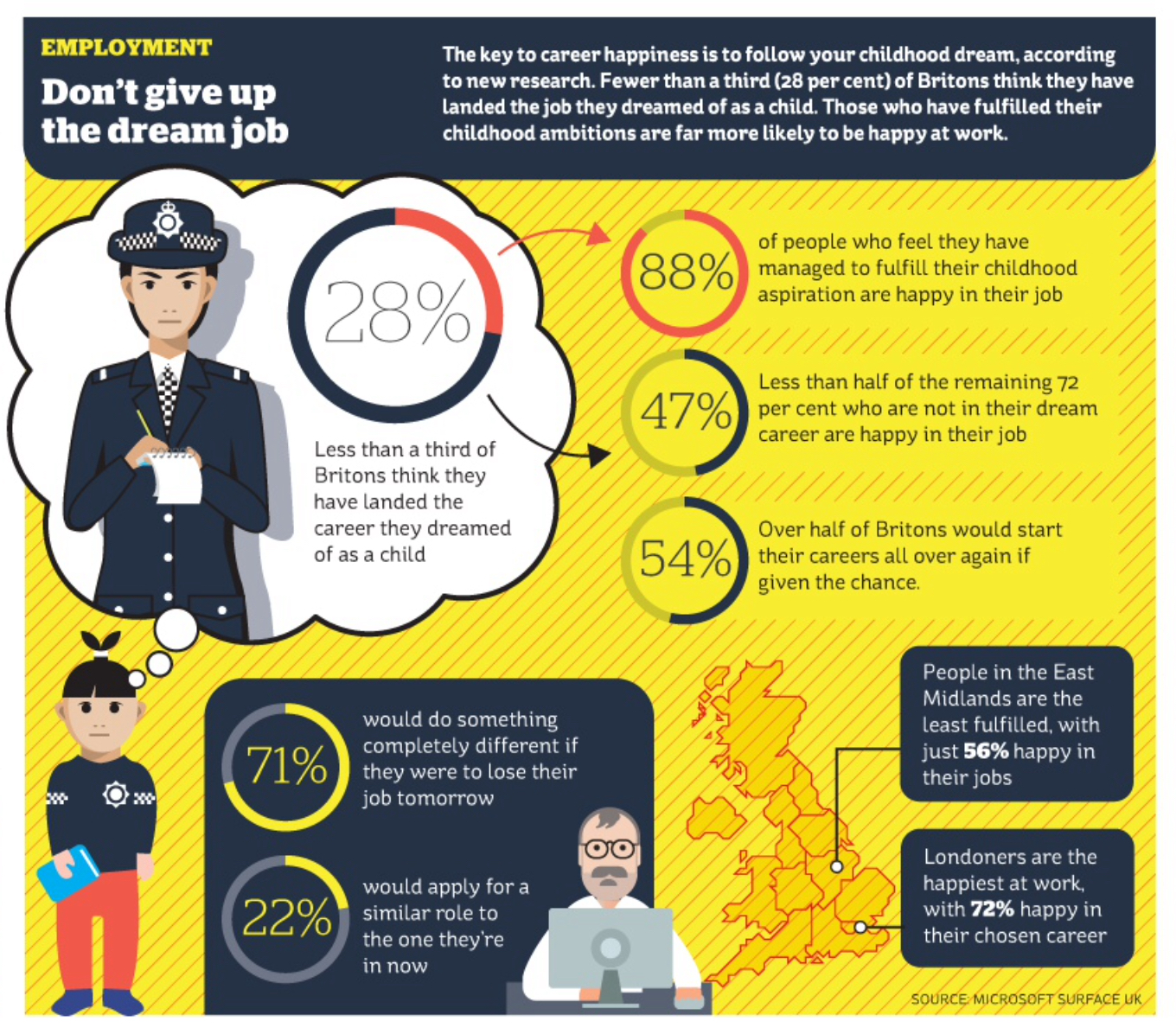
Are we getting the jobs of our dreams?

A recent infographic published in the i newspaper reported that less than a third of the UK's workforce thinks that they're in the "right" job ...


Wednesday, 18 September 2019

And the most desirable employer is ...

Universum Global has published its annual Global Talent Survey which found that Google is the UK’s most desirable company to work for by graduates for the 7th consecutive year. Universum studied 39,500 students from 97 UK universities. Google has widened its applicant pool from STEM graduates with Humanities and Law students both ranking it in their top two and four companies to work for respectively.

Monday, 13 May 2019

Over-educated employees

The Office of National Statistics has said that 31% of graduates are over educated for the job they are doing. For those graduating before 1992, the number was 22%, but this jumps to 34% for those graduating after 2007. London had the highest proportion of over educated workers, with about 25% overqualified for their job. Graduates in the Arts and Humanities were more likely to be under-using their education.

Tuesday, 2 April 2019

Best cities to work in post-Degree

Prospects, the UK agency responsible for graduate employability, has analysed the relationship between graduate salaries and the cost of living in 23 UK cities. Derby is top, due to having many well-paid jobs in engineering and a relatively low cost of living. Southampton and Coventry make the top three, due to their combination of a relatively strong graduate jobs market and affordable living. Leicester and Liverpool are high, although starting salaries are low, they are relatively cheap places to live. Brighton, London and Oxford offer some of the highest starting salaries, yet new graduates will have low disposable incomes due to high living expenses such as rents. 

Charlie Ball, head of higher education intelligence at Prospects, said, “Graduates may need to think carefully about chasing the highest possible salary if it means moving to somewhere with a high cost of living, particularly rents. A graduate may need an extremely attractive offer in London, far above the average salary, for it to be worth them leaving a less expensive labour market ... Graduates need to understand where value lies for their degree and whether it is worth remaining in a well-known jobs market on a lower salary or moving for more money where costs are higher. It’s a common assumption that the latter choice is always better, but the data strongly suggests that it is not.”

Monday, 21 January 2019

You are what you see ...

Research undertaken by Reed.co.uk amongst 18-34yr olds found that 1 in 4 admitted that TV has influenced their career choices. The Apprentice was the top TV programme to influence careers, followed by Dragons’ Den, and then CSI and Law & Order. Love Island was seen as helping to inspire careers in fitness and sales thanks to an onscreen gym ...

Tuesday, 2 October 2018

Aspirations in 2018

The Milkround jobs site surveyed 5,709 ‘Generation Z’ new graduates to find out their views on jobs. They found that 55% plan to stay in their first role for less than two years, 70% said they’d stay in a role for up to five years (and 27% would stay for more than that), if their needs were met. They weren’t overly ambitious, with flexible working (flexible hours and working from home) and training and mentoring, their main requirements. However, they have high expectations on their career choice, with 65% believing that they will work in their dream industry.

And what are their "dream jobs", see a list published recently in the i newspaper:


Tuesday, 1 May 2018

Millennials are reluctant to switch careers

A survey by of 1,000 young workers by Teach First has found that 53% of the "millennial generation" (those born between 1980 and 1999) have remained in the same job sector, with 3 out of 10 not moving on as they worry about starting at entry level in a new sector, or they fear that a career change will not work out. The charity said that the survey disabuses the stereotype of’ "footloose millennials" constantly swapping careers, rather than opting for a job for life and suggests young workers have more in common with prior generations.

Saturday, 4 November 2017

The pay "Gender Gap"

This infographic from the i newspaper shows the differences between pay for women and men around the UK. Looks like recent initiatives to "narrow" the gap have a little way to go ...


Thursday, 21 September 2017

National Trends in Earnings

Using data from the Office of National Statistics Annual Survey of Hours and Earnings, the most recent being October 2016, and excluding self-employed workers or bonuses, the BBC has looked at income for various jobs. They used 'Gross annual pay' and 'Hourly pay, excluding overtime', and selected the median figure rather than the mean, as per ONS advice.

Overall, by May 2017, average weekly pay in the UK was 0.5% lower than the same time a year earlier, after inflation was taken into account. They said that privatisation, unionisation, skills shortages and supply and demand are major factors in determining how pay fluctuates.

Biggest winners 2011-2016
PLUS
Air traffic controllers
54%
Taxi and cab drivers and chauffeurs
44%
Rubber process operatives
39%
Electronics engineers
35%
Publicans
31%
Tailors and dressmakers
31%
Energy plant operatives
29%
Aircraft pilots and flight engineers
26%
Childminders and related occupations
24%
Crane drivers
22%
Biggest losers
MINUS
Health associate professionals, other
22%
Probation officers
20%
Coal miners
15%
Advertising accounts managers
14%
Precision instrument makers
14%
School inspectors
11%
Shelf fillers
10%
Museum archivists and curators
9%
Hotel/caravan managers and owners
8%
Radiographers
8%