This blog is designed to keep you up-to-date with Careers Education, Information and Guidance (CEIAG) available locally, nationally and through the school. I’ll be posting information about employment and training opportunities available locally as well as details of open days and useful websites. The world of education, employment and training opportunities is changing rapidly so keep checking in for the latest information.

Mr Cross


Thursday, 21 September 2017

Is Uni for you?

A survey of 2,612 11-16yr olds by the Sutton Trust has found that 74% said that they intend to study for a degree, the lowest figure since 2009, down from 77% last year and 79% in 2015, from a high of 81% in 2013. UCAS figures show that 32.5% of 18yr olds in England and 29.5% in Wales went into higher education last year, the highest recorded entry rate for both countries. The Sutton Trust said its findings were an important indicator of pupils' plans before they took their GCSEs.

The annual poll found that 14% said they were unlikely to go on to higher education, compared with 11% last year and 8% in 2012, of these, 70% said they did not like the idea of going to university, or did not enjoy studying, 64% cited financial issues, such as wanting to start earning as soon as possible and concern over debt, 44% thought they were not clever enough, or would not get good enough results, and 42% did not think they would need a degree for the jobs they wanted to do. Of those who said they were likely to study for a degree, 51% said they were worried about the cost of higher education, up from 47% last year. The biggest concern was tuition fees, followed by having to repay student loans for up to 30 years and the cost of living as a student.

University Expectations vs Reality

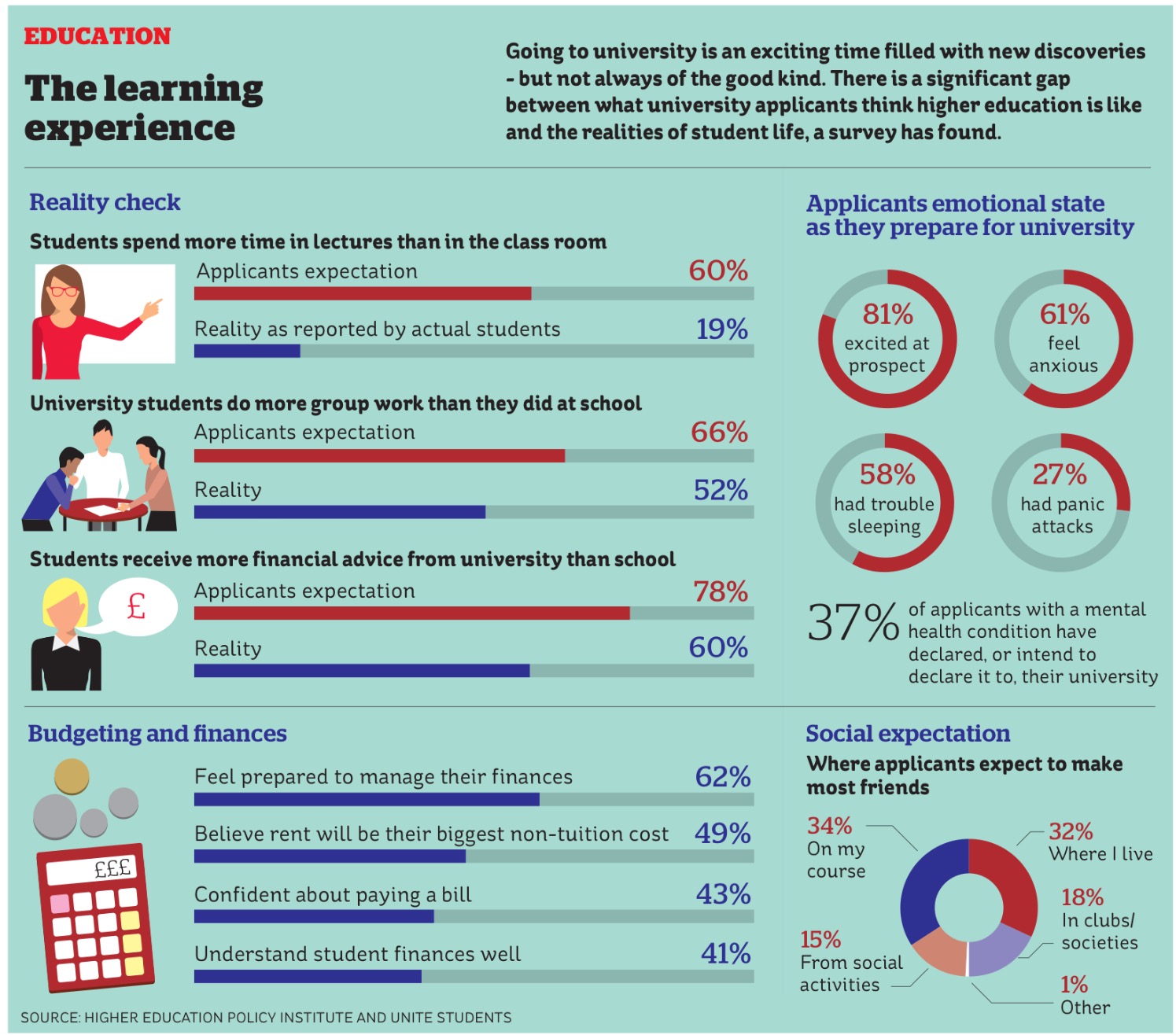
A study by the Higher Education Policy Institute (HEPI) has said that many young people have unrealistic expectations of university, and need much better preparation for what they can expect. Around half a million students begin university courses each year, and the annual HEPI study published earlier this year found that only about a third thought they were getting good value for money. The latest study, based on a sample of more than 2,000 young people, suggests this could be because expectations of university life are unlikely to be matched by the reality.

In terms of contact hours, 66% of the young people surveyed thought university would mean more group work than in school and 60% thought there would be more lecture hours than classroom hours in school. The reality is that for most courses teaching hours will be lower. The survey also found that those from poorer backgrounds were less prepared for meeting strangers and building a new social circle. It also found that young people are not clear about the costs ahead of them, with only about half identifying rent as the biggest expense (outside fees). Others thought that their biggest spending would be on course materials, nights out, groceries or student societies.

Criticism of the Student Loan system

A report by the London School of Economics has concluded that nearly everyone fares badly from the student loan system. The report warned that high earning graduates faced an effective tax rate of 51% in their 40s due to debts from university. In addition, due to rise to 6.1% interest accrued upon taking out the debt, medium earners in essential professions, such as teachers will pay back more over their working life than high earners in law and finance. With a typical male teacher paying £133,000 over their working life, compared to £85,000 for a typical lawyer. 

Sally Hunt, head of the lecturers’ union, the UCL, said, “There are no winners under the current student loan system, just different ways to lose”. Co-author of the report, Professor Maike Halterbreck, said that the report proved that an “in depth review “of the current system was needed, “as soon as possible”.

Tuesday, 4 July 2017

University: Expectations vs. Reality

The i newspaper has published an interesting infographic to show how many undergraduates' expectations of university life can differ from the reality they find when they get there ...


Monday, 3 July 2017

Guidance in applying for Medicine

If you are looking for guidance about applying for a degree in Medicine, the Central Careers Hub has produced a video with just about everything you need to know.  It includes information about the application process, as well as lots of advice from admissions tutors across a range of academic institutions. View the video on YouTube here.

Friday, 9 June 2017

More about Degree Apprenticeships

Degree Apprenticeships are set to revolutionise Higher Education as a credible alternative to a "straight" Bachelor's Degree. What's the difference? Well you get your fully accredited Bachelor's Degree over your (typically) four year course but also get your professional accreditation in, law, accountancy, management, &c as well. The more expensive alternative is to go the traditional degree route and add your professional accreditation on afterwards as a post-graduate course (with the further student debt that goes with it). Oh, and your tuition is free and you earn £15-30k annual salary (with holiday and sick pay) as you go! And if that wasn't enough to convince you, you are much more employable at the end of it because you've got the relevant work experience employers crave. Is there a down-side? Well expect the courses to be competitive, you may well need higher 'A' level grades than the equivalent "straight" degree to get on the course. But if you've got an ongoing salary and pretty much guaranteed job (as opposed to an estimated £67k debt) at the end of it, it's surely worth it!

Find out more from this video.

See what opportunities our out there from the UCAS website here.


Tuesday, 6 June 2017

Degree Apprenticeships at Herts Uni

The University of Hertfordshire is currently advertising Degree Level Apprenticeships in Business Admin and IT at Vauxhall and Software Engineering at Sagoss Ltd. The fifteen Business Administration and I.T. Apprenticeship opportunities will be based at Vauxhall in Luton and will combine degree level academic study at the University of Hertfordshire with job-related learning and experience within the car-manufacturing industry. Find out more here.